
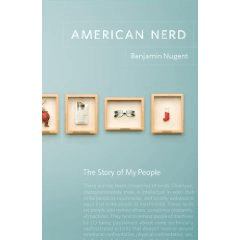
American Nerd 240
Adam Jenkins writes "This book seemed to have potential, particularly since the image of nerds has changed in recent times.
Once objects of derision and schoolyard bullying, nerds are now acknowledged as having a place in society.
The Lord of the Rings became a multi-million dollar movie trilogy, the internet is now used by an incredible number of people,
and computer games are no longer seen as being 'just for kids.' Around the years of the dot-com boom, successful
nerds were driving Ferraris and going to cool parties. So it's not so surprising
that the definition of a nerd has changed over time, nor that a society which has generally become better at accepting
people who are different, has accepted nerds." Read below for the rest of Adam's review.
As is clear from the title, American Nerd sets out to concentrate on the American nerd, and to define what a nerd is.
As with a lot of social labels, it's not so easily defined. Nugent defines two categories of nerd; those who are intellectual and socially
awkward in a machine-like way, and also people who are simply socially excluded. We learn that the word 'nerd' first started being used in
America around the 1960s, but as well as the more recent 'geek', there have also been words like 'boffin' and 'greasy grind' which are similar in meaning.
The book is divided into three sections, with the history of the nerd, a more detailed section called "Among the Nerds",
and a shorter section "My Credentials". The latter section expands on the glimpses into Nugent's life through the rest of the book,
like the case study in the second part about Nugent's friend from the Ghetto of Amherst and includes another case study,
about another of his childhood friends.
| American Nerd: The Story of My People | |
| author | Benjamin Nugent |
| pages | 224 |
| publisher | Scribner |
| rating | 9/10 |
| reviewer | Adam Jenkins |
| ISBN | 978-0-743-28801-9 |
| summary | A history and entertaining discussion of the American Nerd. |
The author spent some his school years being picked on as a nerd and at the start he discloses that consequently his journalistic objectivity is compromised. Later in the book, he tells us that he stopped being a nerd in his teens. As part of this disclaimer, Nugent states that he empathizes with nerds and anti-nerds alike, and really, who better to do that than an ex-nerd? He seems to have done some good research for the book, including attending the Third Annual Anime Los Angeles Convention, SCA events like Estrella War in Arizona, and talking with Rosie Shuster and Anne Beatts, who wrote the first nerd sketch for Saturday Night Live.
The publishers claim this is the first comprehensive examination of nerds, and it's certainly a fine study of the history to date. No doubt there are good related academic papers in the fields of psychology and sociology, and the books of Professor Sherry Turkle (mentioned in this book) sound interesting, but American Nerd is not only more accessible, but it is specifically about nerds. I've read a couple of books which have touched upon nerd culture, but they have mostly concentrated on other topics; usually the stories of early Silicon Valley pioneers and their companies. Nugent's book covers not only the more usual topics like how nerds are treated at school and what a nerd is, but also science fiction fan clubs and conventions, computer gamers, "fake nerds", Japanese pop culture and parallels between race discrimination and nerds. I was a little surprised that some nerd subcultures weren't included, like those around computer bulletin board systems, or tabletop gaming and live action roleplaying. There were lots of analogies and examples from not only movies like Blade Runner, Rain Man and The Nutty Professor, but also classic literature, like Pride and Prejudice, and Frankenstein. Of more current works, there's mention of Beauty and the Geek and The Big Bang Theory, and some interesting information about the production of Freaks and Geeks.
I'm not sure whether the book would appeal only to nerds or ex-nerds. I think the subject material is probably broad enough that it would have a greater appeal. Parts of the book are quite funny like the story about a Super Smash Bros. Melee competition at a Major League Gaming tournament, and the examples of strange vocabulary adopted by gamers. There are also stories about Ben and his interactions with his friend's crazy Mormon Mum. Toward the end of the book, he described getting drunk with popular kids at age 13 in Petrozavodsk, Russia and deciding he didn't want to be a nerd anymore. There was a lot that I learned from this book, not just the history of nerds, but also something of modern subcultures like yaoi, otaku and SCA, as well as some American specific things like RPIs Bachelor journal and high school debating. Though there's some parallels drawn in this book between the UK and the US in the coverage of "muscular Christianity" around the late 19th century, I am sure that currently nerds in the UK are quite different to those in the US, and I did wonder generally just how nerds in other countries are similar and different to the American variety.
This is an intelligent and thought-provoking book, which also manages to be entertaining. Whether you're a nerd or not, you will find parts of the book that remind you of some of your own experiences and make you appreciate how much richer our society is for having nerds!
You can purchase American Nerd: The Story of My People from amazon.com. Slashdot welcomes readers' book reviews -- to see your own review here, read the book review guidelines, then visit the submission page.

Too bad (Score:3, Funny)
All the cool American nerds will be outsourced to India.
I lost it (Score:5, Funny)
Around the years of the dot-com boom, successful nerds were driving Ferraris and going to cool parties.
Damn, I spent all this time playing online MUDs. Why nobody invited me?
Re:I lost it (Score:5, Funny)
Note the use of the word 'successful' in that quote. ;)
Re: (Score:2)
Meanwhile in the 1970s 'unsuccessful' nerds, like John Dolan, were working security in truck yards in Oakland with poor abused old dogs with their vocal cords cut out as their only companions. This is all documented in "Pleasant Hell" which should make a good companion read to a Paul Allen or Steve Wozniak biography.
Re: (Score:2, Funny)
Why nobody invited me?
Because you do not speak like an adult.
Re: (Score:2)
Re:I lost it (Score:5, Insightful)
First, Windows made computers more usable to more people. Admittedly, Apple did it first and better, but Gates did more to bring it to the masses, simply because Apple had so little market share. Second- and perhaps more importantly- he made a s***load of money doing that. Americans have a strong anti-intellectual streak, but they do respect the ability to make unholy amounts of cash.
Nerds. (Score:5, Interesting)
It's curious that nerds, who are generally very precise in matters of technology, are such painfully sloppy writers.
Like, say, this review.
I don't remember the username, but someone on here had an excellent signature for this: "Slashdot, where people know the difference between grep, zgrep, and ngrep, but not there, their, and they're."
--saint
Re:Nerds. (Score:5, Interesting)
When I type, I literally have an inner monologue going on of what I wish to type. A lot of people work this way. It is a means of pre-screening what you want to say so that it would actually make sense if talking directly to other people.
Also, my hands move faster than I can think sometimes. When words like "there/their/they're" come along, my brain just says "there". Especially in a hurry or under stress, my brain doesn't say "WHOA there buddy. That sound can be spelled more than one way depending on the context".
The same mental clog is what, I believe, to be the misuse of words like lose/loose. In quick mode, my brain is much more inclined to type "loose" for the sound "lewz", because most every other word that has a double-o makes the "ew" sounds. Deep in the grey matter, I know better, but when furiously typing away, such things slip.
Re:Nerds. (Score:5, Insightful)
Also, my hands move faster than I can think sometimes. When words like "there/their/they're" come along, my brain just says "there". Especially in a hurry or under stress, my brain doesn't say "WHOA there buddy. That sound can be spelled more than one way depending on the context".
This is where the amazing skill taught in school called "proofreading" kicks in. Before you click "Submit" you pause, re-read what you've written, think about it for a moment, and correct any mistakes. Conveniently, Slashdot even provides a "Preview" button to make this "proofreading" even easier :)
Re: (Score:2)
Re: (Score:3, Interesting)
I think there is a good portion of people that do not consider a post on the internet to be worthy of proof reading.
That's sad. I would imagine there's a pretty large intersection between those people and the ones that claim "language is a living construct, so I can break the rules whenever I want."
On the Internet, we don't have things like body language, voice inflection, or eye contact to help convey extra information. The words that you use become more important in those circumstances, not less.
--saint
Re: (Score:2)
Re: (Score:2)
Also, my hands move faster than I can think sometimes. When words like "there/their/they're" come along, my brain just says "there". Especially in a hurry or under stress, my brain doesn't say "WHOA there buddy. That sound can be spelled more than one way depending on the context".
I have the same issue, except I would say that my brain moves faster than my hands, and I have not time or inclination to go back and fix spelling/grammar errors. It's just slashdot after all, once I submit I'm on to the next comment.
Re: (Score:2)
I think better in pictures. A bit of an over generalisation, but I find that if I can draw a diagram of something I can understand it.
Probably a lot of geeks (I suppose I'm a borderline one) are like that. Think of all the flowcharts, swimlane diagrams, database entity relationships etc that we love. A lot of non geeks try to use words instead.
Re:Nerds, Geeks, & Writing (Score:2)
I guess that almost makes me Geek although my social skills are barely scraping the floor of acceptibility.
I personally like the original Geek Code because it recognized there are different "spins" on Geekhood who were yet a part of an amorphous brotherhood. Y'all have me cooked on the high powered technical stuff as my knowledge is very lateral and includes a fairly strong grasp of english.
Re: "Know X but can't do "Y" (Score:2)
I'm nearly perfect about contractions, but I mangle singular/plural in "what-if" scenarios.
Examples are not nerdy (Score:5, Insightful)
Appreciation of Classic Fantasy != Nerd. There is the subculture who speak elvish and whatnot, but it's difficult to make the case that this makes them "nerds" rather than being classified as "geek" (American nomenclature), "otaku" (Japanese nomenclature), or simply obsessive fanatics.
That might be considered nerdy if we were still living in the 90's. However, there is very little about today's computers that screams "nerd". Nerds are partly responsible for its success, but otherwise nerds are still in areas where we're a bit obsessive about the intellectual pursuits. (e.g. CompSci) At least now we tend to make a lot of money off of it. ;-)
Oh come on. All the cool kids had computer games in the 80s. That was far from the mark of a nerd. It was far more nerdy to brag about how you programmed your computer or calculator to compute Pi to the 100th decimal place. And in any case, computer gaming is on the decline in favor of more sophisticated game consoles.
Re: (Score:2)
It was far more nerdy to brag about how you programmed your computer or calculator to compute Pi to the 100th decimal place.
Or, you could have programmed your computer or calculator with the Pi [esolangs.org] language, which would be even more nerdy.
Re: (Score:3, Interesting)
I think that kind of cuts to the chase of it.
I know more then a few people who went into comp sci for the money. Some of the were the football jocks in high school. However, they wouldn't look at a computer outside of work because it is just an means to an end.
On the other hand, I was intrested in computers before there was any real money in them. If there was no money to be made at all in the computer industry I'd probably just have an expensife hobby.
Re: (Score:2)
Perhaps, but there it's hard to deny that there is a significant overlap between nerds and obsessive fans of fantasy/sci-fi/comics/manga/Monty Python/whatever. Not all obsessive fans are smart enough to be nerds, but I think
Re: (Score:2)
Actually, I think that the term "nerd" came hand-in-hand with the term "nerd bag", the pocket protector that physicists and engineers used to carry their pens in their pockets.
Point being, that LOTR has nothing to do with being a nerd.
Nor do I think that the nerds found a place in society. Rather, the sociably fashionable people have moved into some areas that once were worthy of the term "nerd" back when engineering skills were actually necessary for those fields. But (for example, with computers) you do
Re: (Score:2)
Not when we were talking about the Atari and Commodore 64 computers. Kids saw them as game machines and thus they were cool. Parents thought that these machines were educational devices, but the kids knew better.
Now if you had an IBM PC or Apple II (which were a better experience for everything except games), then you were totally uncool. Especially since the Apple II had a reputation as a classroom computer.
"Geek" subcultures are becoming too mainstream... (Score:2)
Millions of people use Web 2.0 based sites, like MySpace. Usually, they know nothing about computers, which is why they rely on poorly designed CSS stylesheets and automatic site generators that do nothing but lag the Web browser.
Most people play console games, not PC games. Console gaming, thanks to Microsoft and Nintendo, has gone mainstream. I only know a few people who play PC games and have decent gaming PCs. The rest have Xbox 360s and think "PC gaming SUCKS!"
Console vs. PC games... (Score:2)
...I only know a few people who play PC games and have decent gaming PCs. The rest have Xbox 360s and think "PC gaming SUCKS!"
Alright, that's it. Who want some?!? Bring it on. I'll kick your ass in Doom II. Mice and wireless controllers are for wussies. So are LANs.
We're going old school. Just two PCs, a couple of keyboards, pair of CRT VGAs, and a serial crossover cable. You DO know what a serial port is, don't you?!? Bring it biyaatch.
(Sorry, didn't mean to get dragged off into that tangent, but this is a post about nerds...)
Re: (Score:2)
Other genres (like driving games) are usually better on consoles though.
Re: (Score:2)
Likewise, I remember in the 80s when we were listening to "alternative music". Now, all the bands we listened to back then are considered mainstream, when you tune in to an "80s music station" half the songs they play were only on college stations at the time. Punk, synthpop, electronica, etc... are all mainstream
not to be the pedant here... (Score:3, Insightful)
Ok, I feel like I'm arguing over "trekker" vs. "trekkie" here but nerd and geek both started out as pejoratives indicating the socially awkward who stood outside of the norm. Geek has softened over time to indicate someone who may stick out of the norm but whose intelligence and skills help compensate for perceived social shortcomings. Nerd still has a negative connotation.
Re: (Score:2)
Re: (Score:2)
Nerd Gets Cheerleader (Score:2, Funny)
Re: (Score:3, Funny)
That's alright, Louis Skolnick got some... There is hope to all nerds everywhere.
You are aware that Revenge of the Nerds was not a documentary, right?
Led Zeppelin != Turbo Nerds (Score:2, Insightful)
What about ... (Score:2)
Re: (Score:2, Funny)
some would say that they already are in their rightful place.
Re: (Score:2)
<NIEMOLLER>
When they came for the dorks, I said nothing because I was not a dork...
When they came for the tools, I said nothing because I was not a tool...
etc...
</NIEMOLLER>
What does Nerd mean now? (Score:2, Interesting)
One of the meanings of Nerd, the technogeek, has fallen by the wayside. It used to be that staying inside playing Atari 2600 while all the normal kids where outside playing tag made you a nerd.
Nowadays *all* the kids stay inside and play video games all day.
The Nerd label continues to stick to smart kids (a.k.a. kids who try to get good grades).
Stoopid is kool and the Culture of Dum rules.
Maybe that's why American Morons are the most underachieving and get the most expensive public education in the world.
Re: (Score:2)
Re: (Score:2)
Not any more. The Republicans lost the election.
No, now more so than ever. The Democrats who have been running the schools for years are now running the country.
whoah, back up. (Score:2)
society's becoming better at accepting? That's a big leap to make. We still have a long way to go. Anyone who says differently is probably still in college.
what is a nerd? (Score:2)
seems to me, it is someone who is simply technically inclined
in previous eras, this might have meant mechanically inclined, or a good craftsman. in today's world, it implies electronic inclination
but today, and in all eras past, the technically inclined have always done well in society. simply because their skills are prized and rewarded
but then there is the aspect of nerd culture, which, because of perhaps different mental processes of the technically inclined, has existed in a different sphere. its works
*Sigh* Only on Slashdot (Score:5, Insightful)
Will you get nerds and geeks trying to not only define themselves as nerds and geeks but also argue about what it means to be a nerd or geek and which one is more legitimate.
I am a nerd, I know I am. But I'm not ashamed of it because my nerdom allows me make a living doing things that are far from mundane. I don't dread going to work everyday, just dealing with the commute full of those non-nerds that make up rest of the workforce that I have to support in one way or another in my IT endeavors. Just because I'm a nerd doesn't mean I have to fit some pre-described mold. I don't have to be a skinny, socially maladjusted, pasty white kid. I can be physically fit, well groomed and active outdoors with friends that don't cower in the dark fearful of the world either.
There are nerds and geeks everywhere. I have friends who are nurses and paramedics and they live and breathe their medical fields constantly. They know everything about it, inside and out. I can ask them about anything medical and they have some insight for me. But ask them to build a push-pull amplifier using pentode vacuum tubes and adjustable gain control and they wouldn't have clue one. They also wouldn't know anything about the aforementioned TCP/IP stack. Then again, I have friends that are auto mechanics and they can talk at length about the mechanical workings of car but when you start discussing the machine code and C programs used to program and operate the fuel injection computer and they get out of their element quick.
Everybody has a little nerd in them. Just like everybody has a little redneck in them. Just because nerd and geek are seen as derogatory terms in most cases doesn't mean that people who have the nerd or geek mentality about their chosen topic means that they should strive to fit some stereotype. Breaking out of the stereotype invalidates the stereotype and eventually removes that stereotype from common knowledge.
Don't be proud to call yourself a geek or nerd and relish in the uniqueness of the social ineptitude just to say you are different and find your pride there. Be proud to be a geek or nerd because you are different. You are a computer expert or an electronics expert. Be proud that you have skills and abilities that most of the non-nerds don't have. View yourself as an asset to society, as a professional in your profession and present yourself that way. Then people have no choice but to see you as a professional systems admin or engineer rather than one of those "IT Geeks" or an "Engineering nerd".
"Nerd" is a cop-out (Score:3, Informative)
The stereotypical nerd is good at some sort of intellectual pursuit, but socially awkward.
Over and over I see people slotting themselves into these stereotypes "Oh, I'm a good coder so I must be a social disaster".
It's a cop-out. A crutch. An excuse.
Social skills are skills like any other. There are physical aspects to it, as well as intellectual aspects, but it is no *harder* to learn how to interoperate with other people than it is to program C.
The crucial difference of course is that a coding mistake res
Re: (Score:3, Insightful)
I think part of it is more desire, than ability. I often fail to see the point of acting like someone other than myself for no other reason than to impress people, or make "contacts" (an idea that I actually find repulsive). The size of my "social network" is meaningless to me.
I find people always desperately grasping for human contact slightly pitiful, and rather sad. Your measure as a man has nothing to do with who, or how many people, you know, but only with how you value your experience of life. Esp
Re: (Score:2)
They also wouldn't know anything about the aforementioned TCP/IP stack
You aforementioned nothing!
Re: (Score:2)
Voices from the Hellmouth (Score:5, Insightful)
Are we really that much farther away now from Nerd having a negative stigma than we were back in '99 during http://slashdot.org/articles/99/04/25/1438249.shtml [slashdot.org] one of the more famous/important discussions on /.?
Re: (Score:2)
I think part of being a "nerd" is that society has to hold you in slight contempt, no matter what your achievments.
Since leaving school, I still occasionally run into the cool kids from there. Even though I make more money, am cleverer, have a more fulfilling job, have a beautiful wife and could probably kick their arses in a fight, they still act vaguely superior. WTF is that all about?
Re: (Score:3, Insightful)
It's about some people being dicks. They don't act like that towards you because you're smarter or nerdier than them. They act like that to everyone because they're assholes.
Reformed Nerd? (Score:5, Insightful)
I'm not sure I trust the opinions or objectivity of anyone who is a "reformed nerd". That probably will keep me from buying the book.
To reform you have to recognize a problem. To recognize a problem you have to believe that something is wrong. Therein lies my concern.
What am I? (Score:2, Interesting)
I was actually pretty popular in high school and college, a very social individual, played a few (varsity) sports, played in a band, was good with the ladies throughout my younger years, and now I'm engaged to a beautiful lady. However, I'm also unhealthily addicted to video games (played many, many games dating back to the DOS era), a large Star Wars fan (I have action figures, books and cards still), had close to a 4.0
Re:What am I? (Score:5, Insightful)
Narcissistic? Self-absorbed? Insecure and needing validation?
Really: why are you posting all this stuff on /.?
Re:What am I? (Score:4, Funny)
Maybe not so good, but . . . (Score:4, Interesting)
Typical dichotomy of people in America (Score:2, Insightful)
Why does one have to be a nerd, jock, or preppy or whatever. What about working hard at academics, art, and sports? I am not saying that you have to be good at it all; just participating in more than just one area. I guess the ancient Greek values of spirit, body, and mind is what I'm alluding to.
No wonder we've turned into this one dimensional society.
Re: (Score:3, Interesting)
Because US culture is competitive, and anyone who does not dedicate all his time to sports and ever-going popularity contest is seen as a loser. Therefore the only way to win is not to play.
I have nothing against healthy social interaction and reasonable efforts toward personal fitness, however this is not what American culture is about, certainly not among teenagers.
Don't kid yourself (Score:3, Insightful)
I seriously doubt things have changed, regardless of what books or technologies reach blockbuster status in the mainstream. Anyone overly interested in what's under the hood of those blockbusters will still be treated differently. And nerds have always had a place in society: as objects of derision and schoolyard bullying.
Those are america's problems (Score:5, Interesting)
in other countries there arent such distinctions as 'nerds' etc, or such kind of school bullying culture.
lets take turkey for example. in turkey if you are a nerd and its obvious, your future is guaranteed. you are taken as a good student, and everyone treats you accordingly. leave aside the respect you'll be getting in family circles, in school everyone knows your place, and how your place in future will be. this doesnt put you into the 'in' crowd, - there are 'popular' or 'in' crowds in every culture -, but it wont put you out either. you dont get bullied, harrassed or despised.
and stuff unfolds as they predicted generallly - you score top scores in nation-wide university entrance exams, get into a top university (there are 4 major universities here which send graduates to oxford, m.i.t. and similar), and when you graduate from there, you dont even probably stay in a single country, but rather become a top official in a global corporation.
what i know from a number of other countries is that situation is more or less similar to this, around europe. this makes me think that this 'nerd' issue, nerd bullying etc are exclusively american issues.
Re:Those are america's problems (Score:5, Interesting)
Video games now are especially not considered a geek thing anymore. Obviously the popularity of Halo, Madden, Guitar Hero, and Call of Duty have cemented that, but I can even remember going to a party hosted by one of the "popular kids" and even he couldn't resist joining in some pickup fighting game tournaments. Fighting games are definitely nerdy compared to Guitar Hero, but that didn't stop him.
I think the trend of nerdiness becoming socially acceptable is only going to increase. My little brother is an epitome of nerdiness--his computer is an old laptop that runs linux, DWM, and a firefox extension that makes his browser feel like vi. He plans on majoring in math and he competes in the AMC/AIME/USAMO. He also regularly gets calls from girls asking questions or inviting him to parties.
Today the US has no problem with accepting nerds, as long as they can be the least bit sociable.
As for the definitions of "dork," "geek," and "nerd," it's a waste of time. I thought about it for a while, came up with objective definitions that clearly separated them, but found out that even I didn't use my definitions with any consistency.
Re:Those are america's problems (Score:5, Funny)
"My little brother is an epitome of nerdiness--his computer is an old laptop that runs linux, DWM, and a firefox extension that makes his browser feel like vi."
Lies. Everybody knows that the epitome of nerdiness will have a firefox extension that makes his browser feel like Emacs.
Re:Those are america's problems (Score:4, Informative)
Ummm, you do realize the book is called American Nerd right? I mean, it's right there in the title of the article.
Re:Those are america's problems (Score:5, Insightful)
I won't argue that the issue isn't different in different nations. In fact, I would go further saying that there is a strong cultural element. The United States is a large nation, with a diverse array of cultures, even among those with long histories in the country (trying spending a week in New England, followed by a week in the heart of Appalachia, then Texas).
To state that harassment of "smart kids" is only present in America, however, is absurd. I think the US inherited the roots of the practice from European boarding schools centuries ago.
John Draper (Score:2)
Unless this book succeeds in helping explain the existence, mindset and motivations of someone like John Draper, and do so in a fashion that helps a person NOT remotely like him to value his existence, then what's the point of the book?
Social Clubs (Score:3, Interesting)
In it's most basic sense a nerd is anyone not in your particular social circle. Geek is often used in this sense. You have computer geeks, band geeks, football geeks (see 'jock'), and cheerleader geek. We then apply different words to the same label so we get Goth, Emo, Jock, Headbanger, Gearhead, etc.
It is human nature to break down and organize information into discrete catagories. Short, tall, fat, skinny, etc. It's how humans think. If suprises me that we are still writing books about obvious things.
Closed social circles gravitate to extremes. So while most 'jock' for instance are normal decent people the gravitation to extremes progresses if the social circle is closed. In huge schools it's rare to find groups of jocks operating as bullies. There is too much inflow of new people constantly to allow the social circle to become closed. In smaller communities, the agression within social circles rises quicker. Quick enough to hit flash points before people start graduating.
Regardless of the social group, if it is a closed system, it will gravitate to an extreme. The nerd in the 80's sense (i.e. Revenge of the Nerds) would then be a group of social outcasts in their own closed system. Same with their opponents (in a similar closed social system.) This leads to flashpoints of extreme behavior. The urge to conform within the closed social circle and advance within that circle provides the pressure that moves to the extreme. When a social circle hits a flashpoint that pressure is diffused within the social group. Hopefully that flashpoint is a constructive act rather then destructive. The saying, "It's all fun and games until someone gets hurt" is the perfect example of that pressure release. A reality check comes in and diffuses the gravitation to an extreme. The cycle starts over. With enough "fresh blood" coming in with fresh ideas, etc... that slows that pressure from building (until the pressure is high enough to prevent new people coming into the circle turning the initally open system into a closed one.)
Nerds\Geeks\etc.. are a facinating group to study because they are nearly always in a state where their social network is OPEN. I look forward to picking this one up from the review but would love to see more books looking into other social groups as a whole more often.
I can't count the number of football players I played D&D with in highschool. It was weird, we'd chill killing zombies and in school then make fun of nerds. The next day I was DM'ing the nerds and they'ed make fun of the jocks. When college hit I got them around the table together. 20 years later, what a crew of friends to have.
Lack of credentials (Score:2)
If you stopped being a nerd at age 13, you are in no way qualified to comment on what it is like to be a nerd especially since, as any of us can tell you, the vast majority of the crap you will take in your life for being a nerd is in high school.
Nerd, Jock, Geek (Score:2)
For many years now, I've been using Nerd, Jock and Geek almost interchangeable in every day language. I enjoy particularly calling folks "sports nerds" and "math jocks" though I use the "sports nerd" phrase much more often.
Granted the book appears to be about how Nerds have become successful and essentially success is cool so Nerds (or at least successful nerds) are cool. But my point of mixing these phrases is to showcase the narrow focus each has.
Classically Jocks focus on sports to the near exclusion of
nerd and geek vs wannabes (Score:3, Interesting)
Most people who describe themselves as geeks and nerds are wannabes.
Here are some clues.
Real nerds spend long periods of time pursuing their craft while wannabes show up at parties talking about how they are nerds. Much like wannabe writers and poets show up at parties talking about the books and poems they are going to eventually write while the real writers are holed up too busy writing to show up at parties. If you haven't spent long hard weekends working on your craft (be it programming, engineering, writing, music, etc.) instead of drinking and trying to get laid, you are a wannabe.
Real nerds often take common activities and turn them into nerdish activities. For example a nerd friend of mine watched basketball. But part of the watching was he was developing a program to help develop a betting system. Much like how Stephen Jay Gould enjoyed the stats of baseball. If the person doesn't do things like this, they are a wannabe.
If you call yourself a geek or nerd, you are a wannabe. Only others can do this, only others can make you a social outcast. That after all is what the word 'outcast' means, you have been cast out.
If you care about what people think about you and what badges they put on you, you are a wannabe.
HTH HAND
Revenge of the Nerds... (Score:3, Interesting)
Had probably the best definition of both a nerd and a geek.
"A Nerd is someone who is obsessed with computers and technology. A Geek is someone who is obsessed with computers and technology... and LIKES IT THAT WAY."
I'm a geek. ;)
Re:Revenge of the Nerds... (Score:5, Funny)
Geek = Nerd with social skills, and not so much knowledge of the TCP/IP stack.
Re: (Score:2, Insightful)
I disagree. a Geek may be an intellectual master of his field. But they are clueless outside of that field, including in social interaction. A nerd has a broader field of interest and expertise. What the two have in common is that we are both smart and share a common aspect of "freak" culture.
I am a nerd, I am equally at home behind a computer screen, under a car with a wrench, in a shop making furniture or in the arms of my lovable little goth chick.
Re:Revenge of the Nerds... (Score:4, Insightful)
No, you're pretty backwards (at least for the East Coast). Geeks have interests, but are generally fairly socially savvy and competent. You've got music geeks, art geeks, etc.
Nerds are the MIT-esque pocket-protector types.
Re: (Score:3, Funny)
Pop quiz, hotshot ... (Score:4, Funny)
Re: (Score:2, Funny)
I don't believe you've touched a woman.
Re: (Score:2)
"I don't believe you've touched a woman."
You'll have to specify the identity of the woman before we can assist with your conjecture.
"My Karma Broke Down.."
Be thankful that your karma didn't run over your dogma. I knew a guy that happened to.
Re:Revenge of the Nerds... (Score:4, Funny)
I don't believe you've touched a woman.
I bet he has a restraining order that proves otherwise.
Re: (Score:2)
Now if only we had a name for the sort of people who argue over the differences between geeks and nerds.
Re: (Score:3, Insightful)
I think dork covers it. ;)
Re: (Score:3, Funny)
A pedant [wikipedia.org]. I'd shorten that to 'pedo', but that colloquialism is already taken...
Re: (Score:2)
Hey, I didn't write the movie script.
But I personally prefer the movie definition. While I would never qualify as a programmer and "Hacker" is something I would never have the temerity to refer to myself as, I've been working in the networking/IT field for over 10 years now and I would refer to myself as a Geek. Also, my work shirt with the "geek" label on it from thinkgeek [thinkgeek.com] would disagree with you too.
Besides, the movie definition is much funnier than yours.
Re:Revenge of the Nerds... (Score:5, Interesting)
"Computer geek"
"Can't spell geek without a double-E"
and so on...
I agree. The red-necks I went to school with in Stone Mountain Georgia may still think football and cheerleading are more important than math, science, and computer skills, but they can go suck my ever-hard wang. I've started a software company, own a nice boat, house, and car, while working from home and enjoying the country club. And, I married a brilliant woman with an MBA. Sweet revenge.
Re:Revenge of the Nerds... (Score:5, Insightful)
{sarcasm} All hail to you, Count of Monte Cristo!{/sarcasm}
Seriously: At first I, too, thought that it would be nice to show off with my achievements and feast on the look of their faces.
But then I realized that being an academic has another nice advantage: I was able to choose to live in a completely different surrounding in which I NEVER HAVE TO SEE THESE DIMWITS EVER AGAIN.
And to that I say: WOOT ;-)
Re: (Score:3, Funny)
I was able to choose to live in a completely different surrounding in which I NEVER HAVE TO SEE THESE DIMWITS EVER AGAIN.
And to that I say: WOOT ;-)
Don't worry that's what facebook is for.
Re:No revenge needed. Was:Re:Revenge of the Nerds. (Score:4, Interesting)
A wise observation, IMO. I hate to think how mean I was to little girls in the neighborhood before I hit puberty. I think high school is a bit like that - a phase you grow out of.
Still, I can't forgive the rednecks from Stone Mountain. I turned out OK, and I can probably thank the rednecks for part of my drive to succeed (to prove them wrong). But my friends didn't have my luck. Most have never overcome the damage done to their self-image at a young age. I think their lives and all of America would be much better off if we were to build up the self esteem of our most talented geeks.
I read a cool article on being tall. In general, each inch of height is worth about $2K/year in extra income for a guy. However, it doesn't matter how tall you are... what matters is how tall you were when you were sixteen. Guys who sprout in their twenties don't benefit.
Re: (Score:2)
That would be a "goth".
Of course nerds care about these things. The stereotype of the average nerd is socially awkward and generally unappealing visually. Just because they tend to fail at scoring the chicks doesn't mean they don't want one. Just because they can't dress themselves doesn't mean they don't wish they could.
Re: (Score:2)
Correct. Back in high school I would have loved to "dress cool" but never knew how to do it, so I withdrew into computers. And of course I never had success with women, because they wanted the guys who could "dress cool". It wasn't until I moved away from school and into sales (which required formal dress) that I finally got some dates.
It all seems to come back to the clothes. If you don't wear what's cool or stylish, you're going to be shunned.
Re: (Score:2)
That's because clothing is a strong indicator of social status.
Social status (Score:3, Interesting)
clothing is a strong indicator of social status
And yet...people with modest incomes can still afford nice clothes if they want them.
And utter assholes who will use and abuse their women can also afford nice clothes.
It seems silly to me that clothing would be so important as a first-contact filter. But then again I am a geek, and a lot of the status quo seems silly to me. Despite my general distaste for expensive clothing, I own some, have worn it, and have gotten dates. My overall experience of women has
Re: (Score:2)
Well it's not just clothes alone, but also hair style, not wearing geeky glasses, et cetera. It's the overal appearance that can make the difference between "nerd" and "dateable".
Re: (Score:2)
...Just because they tend to fail at scoring the chicks doesn't mean they don't want one....
True. And if for some reason you still have a hard time believing that, just ask to see his pr0n collection.
If you do ask, you might want to take two steps back while he whips out his huge....NAS array.
Re:Nerds will be nerds (Score:5, Funny)
>> Nerds will be nerds and they don't care about their image, the outside world, or those girl thingies everyone is always talking about.
> That would be a "goth".
Right, because "goth" kids don't care about what they look like, and the opposite sex is clearly, obviously not part of goth culture.
Unless you are referring to the goths that appeared after 1990 (post NIN), when the goth image fell to commiditization and every sorority girl was singing "Closer", every other 5th grader had a mohawk or blue hair, and Target started selling spikey wrist bands, bondage-lite collars, and combat boots.
I'm going to go to listen to some Nick Cave and pretend it is still 1983.
Re: (Score:2)
they don't care about their image
That would be a "goth".
That's one of the funniest things I've read today - thank you!
The idea of goths not caring about "those girl thingies" is pretty darned amusing too. They tend to be quite keen on those "girl thingies" who wear fishnet and black eyeliner - y'know, the ones who wouldn't be seen dead with the nerds or the jocks. :)
Re: (Score:3, Funny)
Re: (Score:2)
Academics seem to want to go against common usage and define "nerd" as someone truly interested in knowledge, and "geek" as someone without social skills. This is total BS. The term "computer geek" implies intelligence, and "Revenge of the Nerds" defined nerd as people without social skills.
Parent may be a nerd, and I hope he finds a way to start dating girls, but if he's posting semi-intelligent comments on slaskdot, he's also a huge geek, academics be damned. He should be proud to be a geek, and should
Re: (Score:2)
I think "The Big Bang Theory" provides a good cross sampling of the stero-types and can be used to illustrate the different definitions.
I would classify Sheldon as a Geek and Leonard as a Nerd. Both are smart, but Sheldon has no cares whether people accept him socially whereas Leonard at least makes an attempt.
Layne
Re:Nerds will be nerds (Score:5, Insightful)
Wikipedia has good article [wikipedia.org] on the evolution of the term "geek." Often important issues are decided by the terms used by both sides to define the issue. For example, "pro-life" is used rather than "anti-abortion." Americans have a huge problem: we aren't learning enough science, math, and technology skills. This is especially true for our daughters. In other countries, like China and India, such skills are encouraged and respected.
The battle for the definition of the term "geek" is the same battle. If we want to put America back on track, we need to respect intelligence again, and push all our children to excel in learning science, math, and technology. Like it or not, "geek" is the label for all children who excel in these areas. If we can win the battle over the connotations of being a geek, it will be much easier to properly educate our kids.
Ridiculous (Score:3, Funny)
At school I was one of the more popular kids because of my high intellect. Other kids loved that I would point out their mistakes to them.
And they always let me join in their games - especially the game of 'Wedgie' which I always won.
Re:Ferraris... (Score:5, Funny)
I had a really nice Ferarri in NFS3. Does that count? :-)
Re: (Score:2)
Re:Assumption FTL? (Score:2)
We're talking Nerds & Geeks.
If he was socially aware enough to think about the image that book would portray, wouldn't he obfuscate it? (Hide it, put it upside down, visually dilute the title, etc.)
Then again, if he *was* that aware of the need, does that make them him a Geek vs. a Nerd?